Thursday, October 11, 2007

Weekly Comic Round-Up

Every week (roughly) Aaron goes to the Laughing Ogre in Columbus, Ohio and spends far more money than his wife would prefer. He then comes back here and writes about the comics he reads that he thought were noteworthy. This isn't everything he picks up, just the things that he feels merit discussion - either for being really good, or for having something really wrong with them.
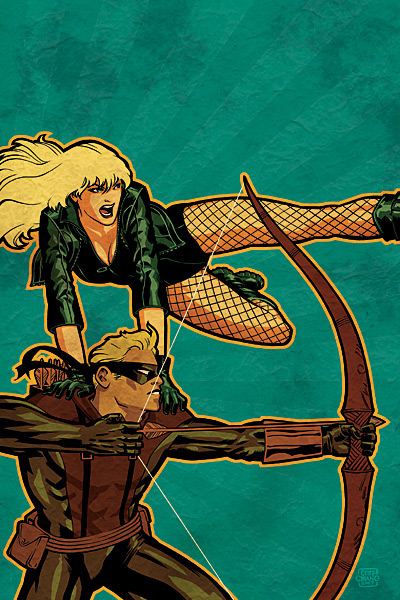
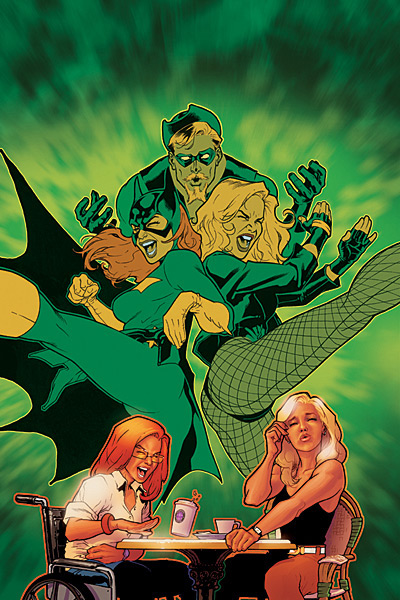
Green Arrow and Black Canary 1
Hey! Look! Connor and Dinah together on the cover! And a caption that this is not the team we expected. I guess that means that Dinah really did kill Ollie on their wedding night last issue.

Sure it is.

Needless to say, Dinah isn’t taking the fact that she killed her husband well. She’s become overtly violent and aggressive, with Connor, Hal and just about everyone else in the DCU telling her to deal with it. Dinah, on the other hand, is convinced that it was a fake Oliver, and that he’s still alive and out there.

And of course, it’s Batman who is suspicious enough to believe that Dinah might be right. An autopsy reveals that Bruce was correct – how shocking. And as the issue closes, we see who has the real Oliver Queen captive.

Pardon me, but what the hell? There are more plot holes in this then I can even begin to deal with. Let’s start with the fact that they did DNA testing on Ollie’s corpse. That should’ve revealed the truth – most shapeshifters don’t get to that level of duplication. But an autopsy performed by Batman and Dr. Mid-Nite will reveal it. Right.

Then there’s the question of how it took place? Dinah should’ve realized it wasn’t actually Ollie long before he came after her with a knife.

And finally, Dinah is among the ten best martial artists in the DCU. Oliver Queen doesn’t even come close (though his son might). She should have been able to disarm and disable the fake Oliver without jamming an arrow through his neck.

They really need to work to pull this out of the nose-dive they’re currently in. I want to like this book – I love Green Arrow and Black Canary. But this is just lame.
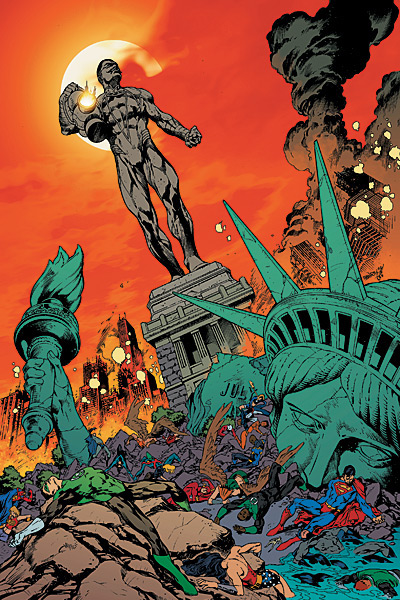
Green Lantern 24
The Sinestro War continues. As the Sinestro Corps comes to Earth, they send the Cyborg and the Manhunters to take out the JLA, as we saw last week in the Cyborg’s own comic. Meanwhile, Superboy Prime leads the Sinestros to attack earth proper.

And Parallax goes after Hal Jordan’s family. Hal flies off to the rescue, and is absorbed by Parallax, but then Kyle and Hal work together to burst free.

Ganthet and his Smurfette arrive and contain Parallax in the lanterns of Kyle, Hal, John Stewart and Guy Gardner – because humans have shown themselves to be especially capable at confronting their fears.

Really? Because, to my knowledge, the only two Lanterns to be possessed by Parallax were Kyle and Hal. That’s not exactly the criteria I’d choose for who to keep it captured.

Kyle does reclaim the mantle of (a) Green Lantern though, which is cool. I prefer him as a Lantern to being the receptacle for Ion. Besides, Ion is going to the Daxamite GL – which is going to be a necessity with Superboy Prime leading the Sinestro Corps.

It was a fun read, but moments that should have been meaningful were rushed.
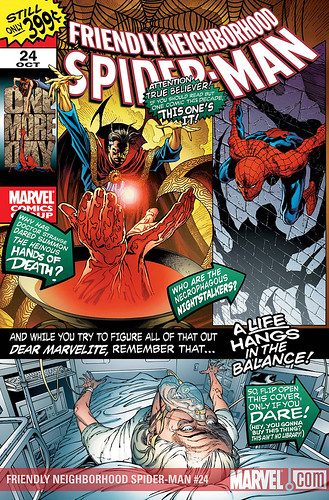
Friendly Neighborhood Spider-Man 24
“One More Day” continues, and now Peter is off to Dr. Strange to attempt to save May’s life. Despite being told by Stephen that May’s death is inevitable, and there is nothing that can be done, Peter insists. And so Strange uses magic to let Peter ask everyone he can think of to help his Aunt. They all refuse.

(Which makes no sense. We have seen that the technology is there to clone a person. We have also seen that the technology exists to transfer someone’s brain into a clone. If anyone has earned this procedure, it’s Peter.)

Peter, being foolhardy, then sneaks magic from behind Strange’s back to go back in time to prevent the shooting from happening. Because the knowledge of Latin from chemistry and biology is enough to use one of Dr. Strange’s artifacts, of course. It doesn’t work, needless to say.

Strange finally counsels Peter to go and be with his Aunt in her dying moments, rather than spending what time she has left rushing around to try to rescue her. Peter agrees, and as he wanders away, he remembers Strange saying that Peter couldn’t change what was meant to be. At which point a little girl shows up and says “But I can.”

Right.

The little girl is probably Mephisto. But even if Pete does go back in time, how does it matter? It has long-since been established that time-travel doesn’t let you change the past, it just creates an alternate reality.

I’ve seen spoilers for the end of “One More Day.” They anger me. But it seems like not only am I going to be mad about the results, I’m not going to be real happy with the journey.

JMS won me back to Spider-Man after the horror that was “The Clone Saga” and “Maximum Carnage.” But now he may have pushed me away from the web-slinger even harder.
Black Adam: The Dark Age 3
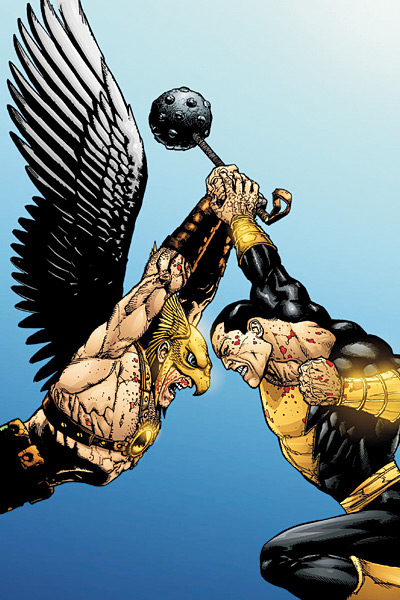
Adam’s quest continues, and wow has it been fun so far. Faust points out what the rest of us noticed, but that Adam had missed. Isis was missing a finger bone, and without that bone, the Lazarus Pit was unable to repair her. But Faust has said that he can bring her back if all of her amulet can be reclaimed.

Using the magic in her bones, Adam is now able to transform once again. So he begins his quest to regain the amulet pieces. The first piece is guarded by Hawkman.

It was a fun little fight, but why on Earth did it last? Adam is able to go toe-to-toe with Superman and Captain Marvel. Hawkman is a tough fighter with wings and a cool mace. The first punch Adam threw that connected should have removed Carter’s head.

Still, this is a minor quibble. The book has been excellent so far, and continues to be so. If you’re not reading it, you really need to.

A few books which don’t deserve an entire write-up, but are worth picking up if you get the chance. Countdown 29 continues again, and after a really strong week for Countdown and it’s crossovers, this week was kind of blah. First, it depended on the events of the upcoming Lord Havok cross-over, and that hasn’t come out. Secondly, the bits with Mary Marvel/Eclipso, The Karate Kid/Triplicate Lass, Holly Robinson and Jimmy Olsen were all a bit flat. And they really lose points for letting the Jokester be Monitored. He had a lot of potential that I wanted to see explored. And if they weren’t going to explore it, then the Crime Syndicate cross-over shouldn’t have been his origin. In Superman 668, Bruce and Clark are looking for the mysterious Third Kryptonian. (Of course, it’s more than that now. There’s Clark and Kara, but there’s also Karen (Power Girl), Krypto, Christopher, and also Zod and company.) The search was kind of uninteresting. Not bad, but uninteresting. But what was worth reading was the interaction between Christopher and Robin. Finally, New Avengers 35 features the team losing it’s first member as a death occurs fighting Zodiac. And then Night Thrasher disbands the team. It could’ve been interesting, but after five issues, I don’t feel like I know these characters. And by now, I should.

And if you’re not reading over there already, keep up with the developments in the world of superhero film and television over at Superheroflix.

Labels: , , , , , ,

Wednesday, September 26, 2007

Listen! Up in the sky!

So, a while back we talked about old-time radio plays of superheroes. Well, three weeks of listening to them haven’t diminished my enthusiasm in the slightest. But there’s one little problem… they’re old.

Now, don’t get me wrong, there is nothing at all wrong with old stories. But it does remove the heroes from our frame of reference - Superman was a different character in the 1940’s then he is today. His relationships with Lex, Lois, Perry, etc. have all changed dramatically in the intervening sixty years, and the modern day listener can be somewhat confused when listening.

Fortunately, a great group of fans has come to the rescue.

The great people at Pendant Audio have been recording audio dramas for several years now. They started off with fan dramas, the first one being Star Trek, and then they moved into superhero audio shows, Superman: The Last Son of Krypton first, than Batman: The Ace of Detectives, Wonder Woman: Champion of Themyscira and Supergirl: Lost Daughter of Krypton.

They’re good stories, grounded in modern continuity, with a remarkably good group of voice actors working on them - all the more remarkable because they’re fans across the internet and not professionals. The different superheroes are also intertwined (no worries, they will provide you with a list of the stories and what order they should be listened).

I’m up to “issue” 6 of Superman: The Last Son of Krypton, and loving it so far. They’re not perfect, but they are a lot of fun.

4 masks out of 5

Labels: ,

Wednesday, September 12, 2007

Superheroic Radio Plays

We've gotten fairly maudlin on here of late, so let's shift gears, shall we? Now, we all know that superheroes are primarily creatures of visual media. Superheroes mainly exist, and thrive, in the brightly colored pages of comic books.

Other superheroes have successfully (sometimes) made the transition to film and television, and we've discussed many of these endeavors, both good and bad, here on this blog.

But imagine, if you will, superheroes you never got to see - but instead only heard?

Ridiculous, you say, but I tell you it's true. Batman, Superman, the Blue Beetle, the Green Hornet and the Shadow all had lengthy careers in radio.

I've spent the last few days at work amusing myself by listening to old episodes of these radio dramas on my iPod. And I thought you, my gentle readers, might enjoy them as well. There are many places to find these old recordings, including through iTunes, but here is a link to get you started.

Botar's Old Time Radio
On this site, you will find archives for many heroes, including the Blue Beetle, Captain Midnight, The Green Hornet, The Shadow and Superman.

But wait! There's more! Modern-day superheroes have made the same endeavor. The winner of Season One of Who Wants to be a Superhero?, Feedback, has his own radio play.

One last exploration of superheroes through the auditory media is the Kingdom Come Audiobook. I can't provide you a link to it (and in fact, haven't been able to find a copy of it on CD for my own purposes), but if you can locate it, it's a blast.

Labels: , , , , ,

Tuesday, September 04, 2007

Five superhero films no one should ever watch

Ever, ever, ever.

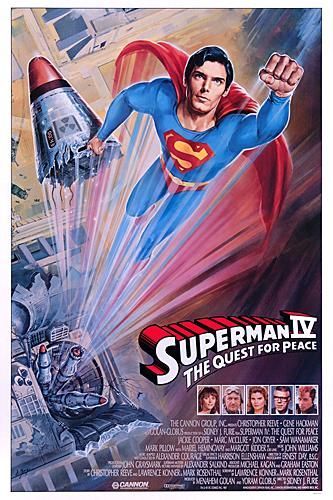
This weekend, some friends and I got together to watch movies. We had three genres, and the group picked the best and the worst in each. One of the genres was "superhero," and the consensus of the group (though not one I personally agree with) was that X-Men was the best, and that Superman IV was the worst (which I do agree with, mostly.)

But it occurred to me that, while The Quest for Peace is pretty much only watchable with either a lot of alcohol, or good friends to mock it with, there are lots of other terrible superhero films. So, here are five of the worst offenders, in chronological order.

The Batman (1943)
I don’t quite know where to begin with my critique of this movie. There are so many wonderful things about it, really, that I’m not sure which to start with.

Perhaps it’s the racial epithets Batman uses to describe our Japanese villain – I mean, really, don’t we all want to see the Dark Knight call someone “a filthy Jap”? Of course, there’s also the fact that this Japanese villain is played by a very Caucasian looking man. We’re not even talking Max Von Sydow as Ming level here, but just a clearly white man. Of special note, there’s Robin’s afro – a classic look, and one which I can’t figure out why they never included in the comics. This coordinates beautifully with the baggy tights which both Batman and Robin sport.

But really, the thing that I find most remarkable about this serial is the fact that, in an effort to end every episode with a cliffhanger, Batman and Robin each seem incapable of fighting off a single thug each. Really, why is this? I can forgive special effects of this era being primitive, and I’m even willing to grant them license for the racial epithets in light of the U.S. preparing to enter the war. But fist-fighting hasn’t evolved all that much in the past 60 years. Simple combat choreography should have been manageable, even then. If you want to inflict a racist, bad-looking Batman on us, so be it. But couldn’t he at least be competent?

Superman IV: The Quest for Peace (1987)
In the late eighties, we were obsessed with worrying about a possible nuclear war. It only makes sense that someone would ask “Wouldn’t it be nice if Superman could take care of this for us?” And that’s what the makers of this film did. But oh boy, did they do a terrible job of it.

First off, it was about the preachiest movie I’ve ever seen. There are nuns in Catholic schools who could learn something about trying to make you feel guilty from this film – if you felt like torturing them in order for them to learn. But even getting past that, it’s just bad. Neither Hackman nor Reeves can save this one, though Reeves is really trying to. He delivers the worst line I’ve ever heard and makes them sound… well, like he means them. Hackman’s performance is phoned in completely, and the movie can’t even be consistent with its’ own rules (Nuclear Man enters a volcano to make it erupt – but he gets depowered without sunlight. And Luthor cuts through Superman’s hair with bolt cutters.)

Which really is what the worst part of the film is – the Nuclear Man. Who is created wearing a cape. Who has a mullet. Whose Lee-Press-On-Nails-of-Doom are what cripple Superman. And who forces us to endure one national monument after another be used to illustrate “Ooh, he’s a bad guy.” And Mark Pillow (yes, that’s his name) doesn’t even get to deliver his own lines! His voice is Gene Hackman’s.

I appreciate the fact that they tried to give Superman a supervillain to fight, but just say no to Nuclear Man.

The Incredible Hulk Returns (1988)/The Trial of the Incredible Hulk (1989)
(I know I’m cheating by including both of these together – bear with me. That's how they're packaged if you buy them - which you should not, but I did.) Lou Ferigno wore a false nose and a wig, in addition to being painted green, in order to play the Incredible Hulk. This only added to how ridiculous he looked – but somehow it worked. And the series was entertaining, in a 1970’s kind of way, probably due to the incredible acting skills of Bill Bixby.

I remember watching re-runs as a kid on Saturday mornings, and really digging them. So when they announced made-for-tv movies with the Hulk returning, I was ecstatic and forced my parents to let me watch them. I owe my parents a lot.
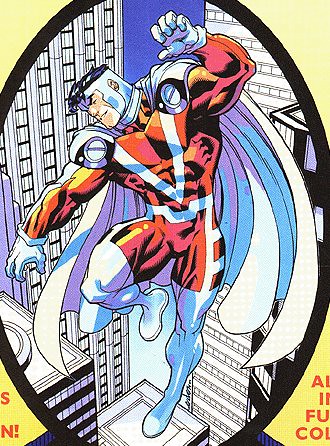
Every single part of these movies was deplorable. The “ninja-costume” Daredevil. Thor, the ancient Viking warrior (not god) who is summoned by (but not transformed into by) Donald Blake. Bill Bixby with a beard. John Rhys-Davis as the Kingpin. It’s just a lot of pain. The even more remarkable thing is that each of these were intended to also be pilots for a Thor or Daredevil series. Obviously, these never came to be.

They were followed up with The Death of the Incredible Hulk, which was a decent enough film, except for the very ending. (Because a fall from a helicopter is enough to kill the Hulk. Really.) A Resurrection of the Incredible Hulk was promised, but never came to be, largely because Bill Bixby passed away before it could become a reality. Of course, frighteningly, these might have been used as pilots for a She-Hulk or Iron Man series.
Ang Lee’s Hulk wasn’t good, but it was a lot better than these two turkeys. Gamma bomb them from orbit, it's the only way to be sure.

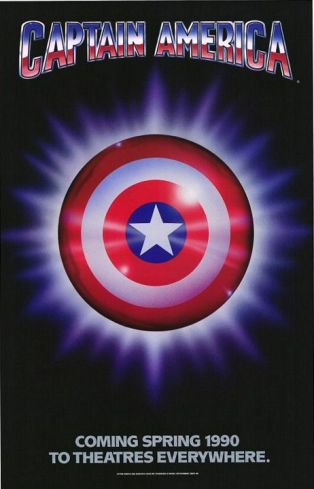
Captain America (1990)
(singing) When Captain America (in his rubber costume complete with artificial ears) throws his mighty (made of hard, ridged plastic) shield…

We cringe. A lot. The costume was atrocious, right up there with the bat-nipples from Batman & Robin. The shield looked like a toy, not the mightiest weapon available to the U.S. A heat gun could’ve destroyed it – so much for an unbreakable shield.

For reasons that will never be known to me, they also decided that the Red Skull shouldn’t be a German Nazi. Instead, he’s an Italian fascist. And his face doesn’t actually look like a skull – it just looks oogie. When Captain America re-awakens in the modern era, the Skull has disguised his appearance by painting the red flesh colored. So, he looks marginally less oogie.

And once more, we’re treated to an incompetent superhero. This movie is only 17 years old. I know for a fact that there were movies made before this film that had good fight-scenes. But “the Living Legend,” the pinnacle of human achievement, the most highly trained warrior produced by the US army – he fights like a drunken seventh-grader.

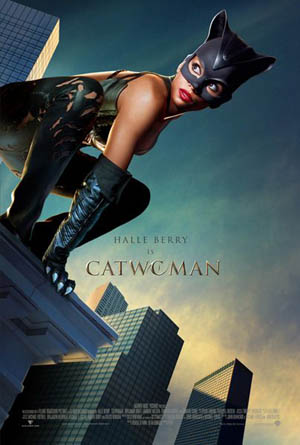
Catwoman (2004)
Do you remember seeing Lee Meriwether, Eartha Kitt, Julie Newmar or Michelle Pfeiffer playing Catwoman? They did so in the 1960’s television series and movie, and then in Batman Returns. Each of them was sexy, cunning and dangerous, and played a marvelous rendition of Selina Kyle.

I remember when they announced that the woman responsible for wasting the role of Storm (and she did) was going to be playing Catwoman in her own feature film. And I thought, Well, this is a waste. Why didn’t they do this ten years ago when Michelle Pfeiffer could have starred in the role? Then they further announced that she wasn’t going to be Selina Kyle, she was going to be Prudence Price. Ok, I thought, well at least this atrocity won’t be connected to the character of Selina Kyle. She’s just some other crazy cat-lady.

And then I saw the preview images from the film. There was a reasonable costume for her to wear, which she began off in. And then there was this one. To which I could only think to myself, Well, I have now seen the only thing in this movie that could possibly be worth seeing – namely a mostly-nude Halle Berry.

Little did I realize how right I was. That image was the only thing worth seeing. Save yourself, and look at the screen-shots, but avoid this film.

So, which terrible superhero films are among your favorite (or most hated?)

Labels: , , , , ,

Tuesday, August 28, 2007

Ten graphic novels for the starting superhero reader

This entry marks the 100th post to this blog, and as a result, I thought I’d do something a little special. Most of you who read this are already dedicated comic book readers, but I do get a fair bit of traffic from random google searches and blog browsing services. Some of these readers may be getting into comics for the first time, or returning after a long hiatus. And so, I thought I’d run down my personal choices for the top ten collections to introduce a person to superheroes.

As always, my lists are arbitrary, based on nothing more than my own personal likes and dislikes. And also, as always, I feel the need to explain a bit about my criteria. To begin with, these aren’t necessarily my ten favorite graphic novels – just the ones I think provide the best introduction to superhero comics. I also limited myself to superheroes (or darn close to them in some cases). There is some amazing stuff going on in comics that has nothing to do with superheroes, including my all-time favorite graphic novel, Maus, but that’s outside the realm of this blog. This list also isn’t meant to be in order of importance – most of these are equally excellent as each other, and I honestly don’t know that I could rank one above the other. Therefore, I listed them alphabetically.

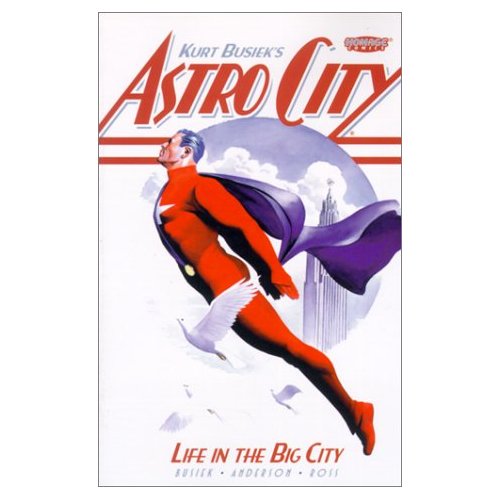
Astro City: Life in the Big City (Kurt Busiek)
Busiek created something remarkable with Astro City – a comic world that feels like it has the same depth and richness of the DCU or Marvel Universe, with characters that seem familiar even as we meet them for the first time. Just as remarkably, the characters he created are evocative of characters we remember from other publishers and fifty years of comic history, but remain unique and interesting in their own right. Samaritan reminds of Superman without ripping him off. Winged Victory bears a striking similarity to Wonder Woman, but has her own fascinating story, and the same can be said of Jack-In-The-Box, Crackerjack, The Confessor, the Silver Agent and others.

What makes Astro City even better is the fact that it doesn’t have the same focus that we see in most superhero comics. Astro City, as often as not, is about the normal people who inhabit the same world as the heroes. And when it is about the heroes, it isn’t about their heroic exploits, so much as it is about their daily lives. Life in the Big City starts off with the best Superman story that isn’t about Superman ever written, as we see what a typical day is like for the World’s Greatest Hero.

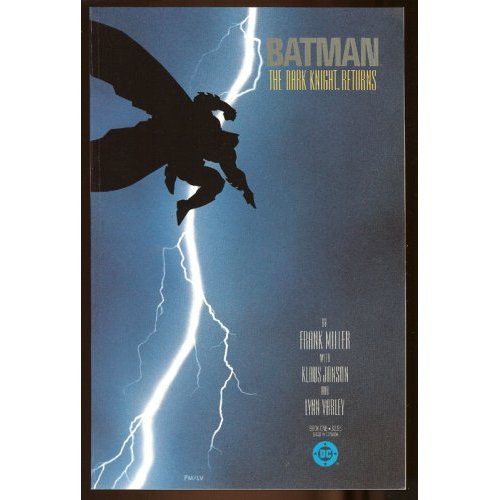
Batman: The Dark Knight Returns (Frank Miller)
Many people have projected the superheroes of the late twentieth century into their near future, imagining what life would be for the superheroes of yore in a new generation, but none have done it as well as Frank Miller did with The Dark Knight Returns.

The transformation of Bruce Wayne into a recluse, and then back into Batman remains gripping, engaging, and visually brilliant. Miller gives us a dark vision of the future, and one that is firmly mired in the politics of the late 1980’s, but that doesn’t take away from the power of this story.
Without The Dark Knight Returns, it’s difficult to imagine Batman Beyond or Kingdom Come ever having been written. The power of this story can even be seen in how elements from this story have worked themselves into modern continuity – Green Arrow’s sacrifice (or not) of his arm, and Luthor as world leader. This comic really marked the beginning of the transformation of Batman from being one of many vigilante detective/martial artists into the driven, darker persona we are all now familiar with.

Batman: Year One (Frank Miller)
Not content to just write the end of the Batman story, Frank Miller went ahead and re-wrote the beginning of it too with Batman: Year One.

Wisely, this comic focuses as much on Detective Jim Gordon as it does on Bruce Wayne. As a reader, we can be thrilled with the exploits of the superhuman, but we can’t ever really understand them. What we can understand are the reactions of the ordinary humans around them.
Additionally, Year One is one of the most beautiful comics ever put together. Year One’s impact can be seen elsewhere in the recent Batman Begins, where Gary Oldman portrayed not Commissioner Gordon, but instead Detective Gordon.

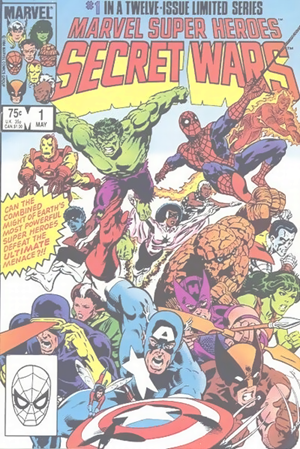
Marvel Superheroes: Secret Wars (Jim Shooter)
The first major twelve-part mini-series that crossed into all aspects of that universe’s comics, the first Secret Wars comic is such a perfect slice of comics in the eighties that it can’t be ignored.

Featuring the best, and most well known heroes and villains of Marvel at the time, it was the first time we got to see Captain America and the Avengers fighting alongside Spider-Man and the Fantastic Four and the X-Men. And they were fighting against the best in Marvel’s supervillains as well (with a few notable exceptions, such as the Red Skull).

Secret Wars reverberated throughout all of Marvel, and its aftershocks are still felt today. Remember that it was in Secret Wars that the alien costume that would eventually become Venom was introduced. It spawned a (far less interesting) sequel, and when Marvel was looking for a mini-series to introduce opposite Infinite Crisis, they even used the Secret War name again.

Beyond all of this, it’s also just a good fun read – and the kind of comic we rarely see anymore.

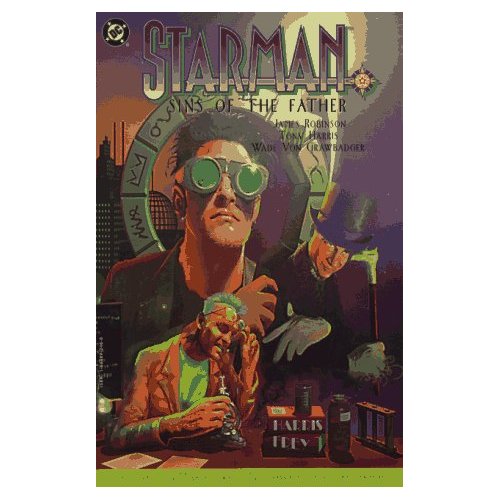
Starman: Sins of the Father (James Robinson)
Jack Knight was exactly what I wanted from my 90’s superheroes. At least, of the ones who identified themselves as such. You know, the whole “we’re not going to wear tights, because that’s ridiculous” movement.

The reason he stood head and shoulders above the rest is that he was unquestioningly a superhero (to the reader at least, he questioned it himself a lot). Sins of the Father did something that we almost never see in a comic – it killed Starman in the first issue of his comic.

Sins of the Father was a great example of how to tell a “darker” storyline without going into the “grim n’ gritty” movement, where sometimes it’s hard to tell who we’re supposed to consider the hero. And it spawned a great series that only got better as it went on. I regret the fact that Jack retired as Starman, and passed his cosmic rod onto Stargirl, but as a father myself, I understand and applaud his choice. You'll want to read the whole thing, once you get through this volume.

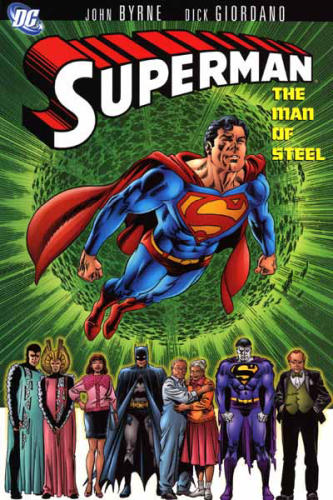
Superman: The Man of Steel (John Byrne)
Before Crisis on Infinite Earths, Superman had become truly ludicrous in power. He could fly nearly at the speed of light, was able to push planets around with his bare hands, and nothing that wasn’t magical or made of kryptonite could so much as scratch him.

The list of his secondary powers went on and on – not just heat vision, x-ray vision, microscopic hearing, ultrasonic hearing and super-breath, but also super-mesmerism and whatever other odd power the authors felt he needed. (The cellophane “S” from Superman II is almost understandable in this context.)

In the aftermath of Crisis, the editors at DC wisely decided to tone Superman down a bit, and they gave that job to John Byrne.

The Man of Steel isn’t the most elegant comic ever written, it has a lot of re-introductions to take care of. But it does so in a fairly admirable and entertaining way. And a lot of what we now think of as “cannon” for Superman and company originates in these pages. Byrne gave us Lois, the daughter of an army general and a very competent investigative reporter. He gave us Lex Luthor as a wealthy industrialist – both of which have been incorporated into every incarnation of Superman created since; the animated series, Smallville, Lois and Clark, and Superman Returns. The Man of Steel redefined Superman for a generation, and therefore is really a must read.

Supreme: The Story of the Year (Alan Moore)
I mentioned this is my Top Ten Superman Pastiches list, but it merits being mentioned again. Supreme: The Story of the Year is a loving deconstruction of the Superman mythos – complete with touching on how heroes get re-invented every generation, and all the trappings of the Silver Age.

But Moore doesn’t do this as a scathing commentary on the era, nor does he do it to make fun of the characters or genre. While I think that Astro City Vol. 1, Issue 1 is the best single issue of a Superman comic that isn’t actually about Superman, I think that this is my favorite Superman graphic novel without actually being about Superman.

It also does the best job of explaining why comic continuity can be such a mess to the novice reader that I’ve ever seen. On top of that, it’s illustrated wonderfully – very evocative of the style of Marvel and DC in the 1980’s, but on the higher quality paper and coloring techniques of the modern era.

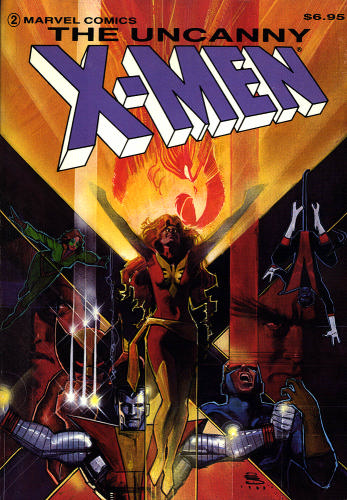
X-Men: The Dark Phoenix Saga (John Byrne & Chris Claremont)
Jean Grey’s tragic tale is as big a part of comic book history, and as important of a single event as the shooting of Bruce Wayne’s parents, or the rocketing of baby Kal-El to Earth, or the bite of a spider on Peter Parker’s young hand. It has become, unfortunately, muddled with ret-con after ret-con, new incarnations of the Phoenix-force, and the three thousand, four hundred and eighty-three resurrections of Jean Grey.

But that doesn’t change the fact that the original tale is about as good of a story as you’ll find anywhere. The battle in the Hellfire Club is a great warm-up battle for the X-Men (and one that would have future impact on the X-Men, especially Wolverine), and the battle on the dark side of the moon against the Shi’ar Imperial Guard is a superpowered slugfest that has rarely been matched.

Just as significant, this story was the one that really cemented the strength of the bond between Jean Grey and Scott Summers – the best romance in comics in my opinion.

Ultimately, I wish that they had left Jean dead at the end of the Phoenix Saga. Her rebirth, again, opened the floodgates wide for superheroes returning from the grave. The great truisms of superhero death, Bucky and Captain Mar-Vel, have even now been violated. Fortunately, you can read this comic without worrying about the future resurrection after resurrection.

Ultimate Spider-Man, Vol. 1 (Brian Michael Bendis)
By the early years of this millennium, Spider-Man’s life and continuity had become, frankly, a mess. Somewhere between Carnage and clones, I swore off Spider-Man comics. The continuity was ugly, and I felt like I no longer knew these characters.

I still occasionally saw Spidey in other titles I picked up, and vaguely missed him, but he was out of my life. I had been abused one-too-many times, and it was time for me to move on. But then Marvel created Ultimate Spider-Man. Written by a (then) up-and-coming writer by the name of Brian Michael Bendis, Ultimate Spider-Man featured a sixteen-year old Peter Parker in the modern era, facing re-imaginations of Spider-Man’s classic foes. The Green Goblin no longer relied on gadgets – Norman Osborn transformed into a giant green creature capable of throwing fire from his hands. The early romances of Peter Parker’s life were largely ignored in favor of immediately focusing on MJ. And Nick Fury looked like Samuel L. Jackson instead of Clint Eastwood

“A publicity stunt,” people said. “It’ll never last.” “It won’t be any good.”

Were they ever wrong. The rest of the Ultimate continuity has gotten a little messy, and I can’t say I fully approve of all the changes they’ve made, but Ultimate Spider-Man has remained one of the best comics on the market. Even my favorite titles tend to have ups and downs, but there hasn’t been a single issue of USM that I haven’t enjoyed reading.

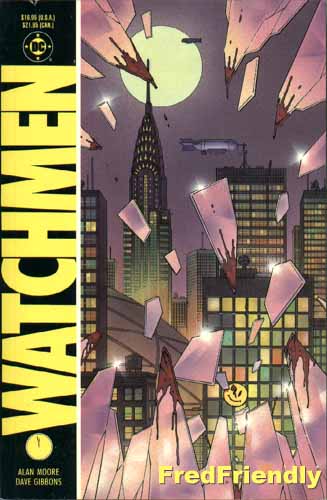
Watchmen (Alan Moore)
No list of great comic book graphic novels would be complete without including Watchmen. Alan Moore’s masterpiece has been analyzed more than any other comic collection, and sparked more debate and discussion as well.

Superhero comics changed forever after the publication of Watchmen, as people began looking at their heroes as beings who had feets of clay. Finding true heroism in Watchmen takes a lot of digging, and for the most part, the heroes fail. But they make the world a better place – at a price.

It was also the first time we saw our heroes behaving in ways that were really ugly. The Comedian rapes the Silk Spectre, Rorshach is a certifiable sociopath, and Nite-Owl has let himself go and now has a beer-gut.

Oddly enough, I don’t really like Watchmen. I consider it important to comics, and well-written, but I blame it for much of what I now find unpleasant in superhero comics. Still, if you’re going to read modern comics, then Watchmen is an important thing to read. The trends in modern comics originate here.

That's my list, and I hope you enjoyed it. So, what do you think I missed? (Other than Crisis on Infinite Earths). Let me know, and thanks for sticking with me through the last hundred posts. Here's looking to another hundred!

Labels: , , , ,

Monday, August 27, 2007

Superheroes and advertising

“After spending an entire night fighting Venom, the Hobgoblin and Doctor Octopus, there’s only one thing that makes me feel like a human being again – and that’s new Mountain Dew: Extreme.” – Peter Parker

A ridiculous idea you say? Well, it is, but why do we think that really? We make fun of heroes like Captain Amazing and Booster Gold for product endorsements, or wearing an advertising patch on their costume – but if superheroes actually existed in this world, why wouldn’t they do that?

The responsible thing, some would say, would be for heroes to let any money made off their image go to a charity. That’s what Superman does in the DCU, after all. Money made from the sale of Captain America merchandise no doubt goes to the Federal Government in the Marvel Universe. But what, I ask, is so wrong about a hero being paid for the work they do?

Fighting crime is a tough gig, and it can make holding a regular job really hard. So, doesn’t it make some sense to let heroes earn their living by doing what they do? After all, real-world heroes, firefighters, police officers, soldiers and teachers get paid to help society. It wouldn’t even require that the hero give up their identity to the public, so long as there was a trusted individual or corporation who could collect their earnings and distribute them. The Avengers could certainly act as a clearing house to take in the money and then provide it to their members, as could the Justice League.

Heck, in the Marvel Universe, Reed Richards funds the Fantastic Four through a combination of merchandise and patent-sales. And no one ever criticizes him for it. The Wasp uses her status as an Avenger raise attention to her designs, and even models them as superhero costumes, and no one hires Jennifer Walters as an attorney without being very aware that she is the Savage She-Hulk.

So, if a hero wants to take an endorsement deal from Nike, why not let them?

Especially since we're perfectly comfortable using them for advertising in the real-world. And they don't even see a cut of the profits.

Labels: ,

Thursday, August 23, 2007

Weekly comic round-up

Every week (roughly) Aaron goes to the Laughing Ogre in Columbus, Ohio and spends far more money than his wife would prefer. He then comes back here and writes about the comics he reads that he thought were noteworthy. This isn't everything he picks up, just the things that he feels merit discussion - either for being really good, or for having something really wrong with them.

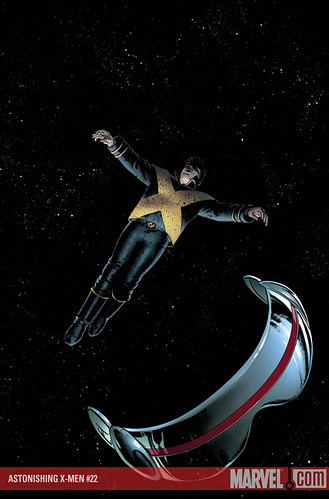
Astonishing X-Men 22

When Josh Whedon took over this comic, I about lost my mind with excitement. And he had a good run for awhile there, but I’m losing interest as this goes on. The character moments are great, but the plot is kind of lacking. Examples are the bedroom discussion between Kitty and Peter, the confrontation between Emma and Danger (as Emma correctly predicts that Danger is unable to overcome her programming to actually kill someone – though I’m fairly certain the Danger Room had an override to allow it to use lethal force), and the “final” act of leadership from Cyclops as he sacrifices himself piloting the ship to give the team the diversion they need.


Of course, Cyclops isn’t dead. For all the craziness that Marvel is willing to do right now to shake up their universe, they wouldn’t have Scott Summers die in such an off-hand manner.


But while the character moments are great, and I’m loving them, even –shudder- the romance between Scott and Emma, the plot? I can barely follow it, and don’t care enough to go back and re-read the issues to put the plot back together. This bodes ill for the future of the book.


Superman 666

Superman has fairly consistently been well-written, but rarely worth commenting on of late. I’ve enjoyed almost every issue of the different titles, but none of them have been anything all that special. But this issue begged for the attention.


Why? Because it was written by Kurt Busiek and illustrated by Walt Simonson?

Nope.


Because it featured the Phantom Stranger and Zatanna?

Nope.


Because we got to see Superman’s darker side shining through?

Nope.


It begged for attention because it was issue 666 – the number of the Beast, and DC went for the obvious and had it focus on a Kryptonian demon.


Don’t get me wrong, it was actually fairly entertaining. And in a black humor kind of way, it was fun watching Superman lay waste to all the things which must have annoyed him. He is, after all, one of the most powerful beings on the planet. Being forced to hold back, instead of lashing out at all those things we would lash out at if we had his power must be endlessly frustration.


But it would have been nice if DC could have avoided the obvious.


Thunderbolts 116

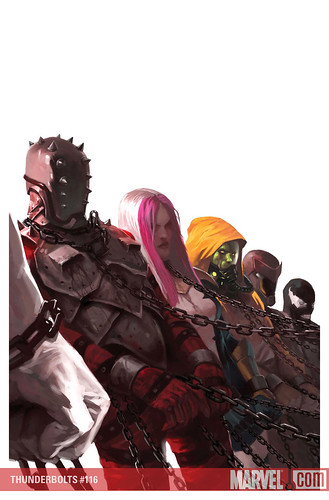
After a disappointing month for the Thunderbolts, this issue once again has renewed my interest in the comic. I think a large part of my problem with the direction of the comic is that, under Osborn, and with individuals like Venom and Bullseye on the team, the Thunderbolts really are supervillains pretending to be superheroes – like they were at the beginning. However, that only remains interesting for so long. The brilliant part of the Thunderbolts under Busiek was watching the villains really become heroes.


We lost sight of that for awhile, but with Songbird temporarily leading the team, we’re seeing it again. I found the use of Venom as a potential cannibal to be really fascinating – both Songbird’s use of it, and Gargan’s reaction. Gargan obviously has a very different relationship with the symbiote, or at least he wants to. As I’ve said before, the idea of Venom as a hero bothers me a lot, but done in the context of the Thunderbolts, with someone other than Brock being the symbiote’s partner, it could be interesting to read about.


But the real star of Thunderbolts right now has to be Robby Baldwin. Once (and possibly future) Speedball, Penance has really become something. He’s a loose cannon to the extreme, and by all accounts, is nearly Hulk-level in power. Moonstone is crazy if she actually thinks Osborn can control him, and if there’s one thing I know about Moonstone it’s that she’s not crazy. Osborn, on the other hand, really is. So, it’s possible that Karla is playing him.


(And as a side-note, I’d really like to see Karla re-encounter Hawkeye. It’ll be fun if the Thunderbolts are ever sent after the New Avengers.)


Finally, this issue introduced a new unregistered superhuman combatant, who objects to the registration act, wants to summon the Thunderbolts, and is a powerful telekinetic. Based on the level of power, and the desire to see the Thunderbolts, I almost think that it’s Vance Astro behind the mask of Mindwave. My hesitation in predicting this is based on the level of violence displayed to the police officers in the station – Justice is many things, but not a killer. And even if none of those officers die, they were pretty severely banged up. But it would make sense for Justice to want to draw out the Thunderbolts to check in on Speedball. Anyone else have any ideas who might be behind that mask? I’d love to hear them.


Birds of Prey 109

I can’t even begin to describe how excellent Birds of Prey is. On the one hand, the writing of the characters is top-notch and the action is exciting and well-drawn. The comic balances superheroism and the personal lives of the characters just about perfectly (occasionally focusing on one or the other, but never for so long that the other suffers for it). The cast is made up of a great group of characters, and the relationships between them are rich and fully defined without being needlessly complex. And the comic frequently includes moments of genuine humor, without being a “silly book” like She-Hulk.


And on the other hand? It’s a comic about women superheroes that manages to offer up everything we would like to see in any comic, without pandering to either hard-line feminists or male chauvinist pigs. Women can read this comic and see superheroines acting like superheroines instead of being relegated to supporting roles. Men can read this comic and not feel guilty for their gender.


This issue illustrates all of these points. We get to see great character interaction between Barbara and Dinah, as they discuss Oliver Queen’s past history with them, and other women in the DCU, and what it means that he has proposed to Dinah. Barbara walks the delicate line of trying to warn her friend, but still being supportive, and it feels absolutely real to me. On the humorous side, we watch as Sin teaches Barda how to play Pokemon, and convinces her that it is really a game for warriors. Then we get to watch as an innocent fight between Scandal and Knockout leads to Knockout charging after Barda for a rematch – during which she is caught by one of those responsible for the killings of the New Gods.


Action. Character development. Tie-ins to the major plot points of the DCU. And all of this in a comic that writes female characters as genuine characters.


My only regret is that I held off on picking this title up until a friend of mine started loaning me the graphic novels of the earlier parts of the series.


Amazing Spider-Man 543

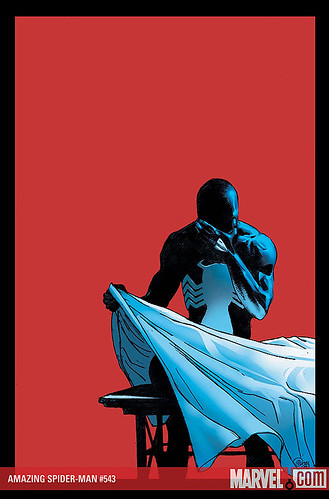
I know that JMS is leaving this book, and for that I am truly sorry. It was on the strength of his writing right before Civil War that I was pulled back into the adventures of the 616-Peter Parker. And here in the Back in Black storyline, he has continued to remind me of why I used to love this character, before he jumped the shark with Carnage and Clones.


Spider-Man may not be the most powerful hero in the Marvel Universe, but among the street-level heroes, he’s pretty much the cream of the crop. And JMS knows and respects that. Spider-Man is an absolute terror when fighting normal humans, and is capable of pushing himself to deal with much more powerful foes. But Peter Parker is an intensely vulnerable human, especially where his family is concerned.


It fits with Peter’s life for the emergency transfusion he gave Aunt May to not only not help her, but to be considered proof that the poor old Jane Doe is being poisoned by her niece. And watching desperation push Peter into committing nine felonies in a row was a fascinating descent. Of course, he’s probably guilty of more crimes than those, among them breaking into a maximum security facility, assault and battery, and menacing.


Still, I understand Peter’s crisis. For one of the first times, any illegal actions he’s taking aren’t based on “what must be done” to fight the bad-guy, but instead based on his own self-interest. (There’s an incident with a golden notebook from Secret Wars II, but that’s hardly worth mentioning, especially considering how much Peter tortured himself over it.) He also threatened a man with death, and it was fairly clear he wasn’t kidding.


“One More Day” starts next month. Poor Peter is going to go through hell, and I’m going to watch it with a perversely sadistic sense of glee. Heroes are defined by how they deal with the impossible situation. For what it’s worth, I think Peter is a true hero, and will come through this showing that. This will be a testament to his heroism, not the beginning of his fall. Or at least, that’s my prediction.

Labels: , , , ,

Thursday, August 16, 2007

A short round-up

Every week (roughly) Aaron talks about the comics he reads that he thought were noteworthy. This isn't everything he picks up, just the things that he feels merit discussion - either for being really good, or for having something really wrong with them.

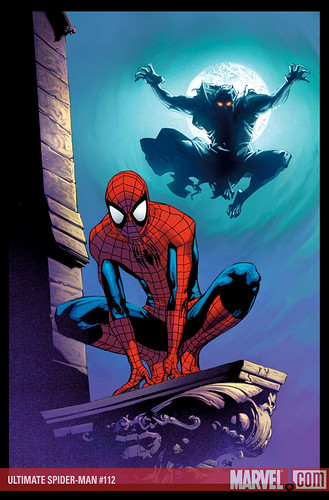
Ultimate Spider-Man 112
Bagley has left us, but Ultimate Spider-Man soldiers on. Fortunately, for me at least, the priority is on the writing, not the art – and Bendis is still at the helm of this ship, something which shows in the plot, pacing and characterization of this issue.

A brief battle with the shocker makes both Peter and Kitty (sporting a new costume) late for class - a class where they get assigned the dreaded Baby Project.

(You know the one, where you have to take care of a faux baby. In my day, it was an egg. Nowadays, it’s usually a doll, sometimes with sensors.)

Even worse, Kitty and Peter get assigned together, much to MJ’s annoyance. Being MJ, of course she tells them to just do the project. Of course, tension will further develop around this project; there’s really no way it could be avoided. And Bendis will make it interesting, engaging, and embarrassing for Peter.

But that’s not what makes this issue noteworthy. What is noteworthy is that Norman Osborn is back. Initially prepared to make a deal with Nick Fury, only to be told that Fury isn’t around, Osborn later breaks free. We don’t get to see anything in this issue, but the cover of this issue as well as next month’s promises a massive battle between the Spider and the Goblin once more.

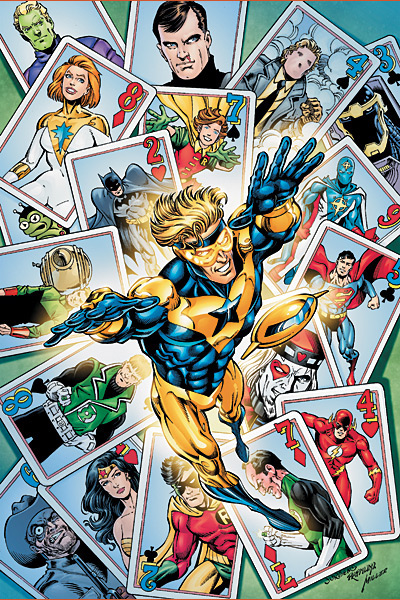
Booster Gold 1 I’ve never been the biggest Booster Gold fan. I’ve never disliked him, per se, but he’s just never impressed me. Maybe it’s because it’s hard for me to sympathize with his life, or why he wanted to be a superhero. I became marginally more interested in him during 52, especially after he “died” – and then the revelation about who Supernova was. This left me interested enough that I decided to pick up Booster Gold 1, and I’m glad I did.

Booster wants to join the JLA again, and when he calls them in the midst of a battle against the Royal Flush Gang, the reaction among the league is mixed. Many of them dislike Booster and his glory-hunting. But Batman and Superman are both able to point out actions where Booster did the right thing, despite the personal cost. So, the League gives him a week to prove himself without being a glory-hound. And Booster manages it.

Just in time to be told that Rip Hunter wants him to save the timeline. And in order to do that, Booster must keep anyone from ever taking him seriously. No one must ever know of the good that he’s done. And so, right at the moment when the League offers him membership, Booster has to act like a boob.

It impressed me, honestly. I can’t imagine making myself look like a fool to the people I most respect – even if it is for the greater good. Of course, Booster tells Rip that there’s a catch – if he’s going to do this, he wants Ted Kord (the Blue Beetle) brought back. Booster knows it’s possible, and that’s his condition. Based on the preview, it looks like he just may get his wish.

Throwing a wrench into all this is the future of Supernova, Booster’s ancestor, and how he may now be dealing with a version of Sinestro.

-sigh- Fine. They’ve got me. When does Issue 2 come out?

Justice League of America 12
This is possibly one of the best issues of JLA I have ever read. Ever. And I had to double-check that Brian Michael Bendis didn’t write it, because it follows what he does best. We want to see our heroes engaged in epic battles, no question. But if we don’t care about them, it means nothing. So what better way to explore who they really are than by examining how each member of the League (other than the Big Three) handle Monitor duty.

And it was great. We really got a good look inside of the heads of Black Lightning, Black Canary, Red Tornado, Red Arrow, Hawkgirl and Geo-Force. We got to see previews of upcoming issues the league will have to face - Geo-Force and his involvement with Deathstroke and how the Big Three are trying to use him as a double-agent; the inner struggles being faced by Vixen with the loss of her powers (almost) and Red Tornado and the loss of his humanity (almost); and the budding relationship between Roy Harper and Kendra Saunders. Superhero romances are rarely smooth, and these two have serious emotional commitments that will make things even worse than normal. The only real question is who will kill them first; Cheshire or Hawkman?

The not-terribly-unusual framing device for the issue was a nice touch, as we watch J’onn J’onzz and Arthur watching the league. These two have always been outsiders, and the League means more to them to probably any other hero. But what I found most impressive in this issue was letting Black Canary show why she deserves to be the League Chairperson. Dinah has been getting more and more respect in the DCU over the last several years, in the pages of JLA, JSA, Birds of Prey, her own title and Green Arrow, and I can only say “About time.”

It’ll be sad to see Meltzer leave this book, but the issue was about as solid an ending as I’ve ever seen.

Labels: , , , ,

Wednesday, August 01, 2007

Smallville: A good time to be a Kryptonian

So, it seems like this season is going to be the season of guest stars for Smallville. We have Justin Heartly returning in his role as Olliver Queen, along with other members of the Justice League (some returning, and possibly some we haven't seen before.

Poor Tom Welling gets to play double-duty, at least for part of the season, as we know that Bizarro will be back for at least two episodes. And we'll have a new visitor from Krypton in the form of Laura Vandervoot.

But what I'm most excited about? Two cameos for former Kryptonians.

Dean Cain, who was Superman/Clark Kent in Lois and Clark has been confirmed as a guest star. I won't reveal any spoilers about his character here, but details can be found over at KryptonSite.

Just as interesting, however, is that Helen Slater, who formerly played Kara Zor-El in the all-too forgetable Supergirl movie, will very possibly be playing a recurring cameo role on Smallville.

Add in more appearances by the John Jones, the Manhunter from Mars, and one almost wonders when we'll actually see any of Clark, Chloe, Lana, Lex or Lionel.

Labels: , ,

Tuesday, July 24, 2007

Of man and superman...

And here's part two of the countdown.

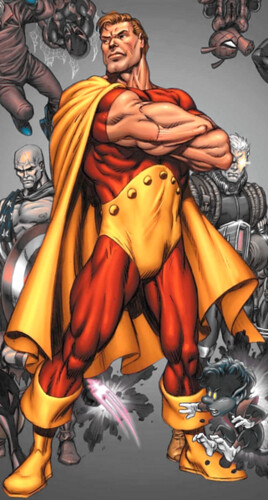
5) Hyperion (Marvel Comics - Supreme Power version)
Mark Milton is the sole survivor of an alien race, rocketed to Earth and given over to the custody of the United States government. As the child grew, his powers grew as well, and the young Mark found himself possessed of unearthly strength, the power to fly, enhanced senses, atomic vision and superhuman speed. The arrival of Mark's rocket sparked other superhumans - in some cases granting powers to normal humans, in other cases re-awakening long dormant powers. Leading many of them as the head of the Squadron Supreme, Mark Milton is no doubt the most powerful being on Earth.

Why he's number 5: First, please excuse me for the fact that I'm talking about the Supreme Power version of Hyperion, but using a picture of the old-school Hyperion. I just like the visual better. Hyperion is a very straightforward pasting of Superman, right down to the aliterative name. (Yes, Clark and Kent start with different letters, but they're the same sound.) His origin differs once he gets here, but the infant that would become Hyperion could very well have been Kal-El. It again comes down to attitude - Hyperion sees himself as a hero, but he is far more brutal than Clark would ever allow himself to be. Part of that comes from the fact that Hyperion never had the chance to be human - something that defines Clark.

4) Samaritan
(Homage Comics)
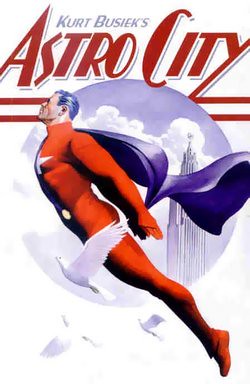
The man who calls himself Asa Martin in his daily job at the Astro City Current is, in fact, Samaritan. A displaced traveler from the future, sent to save our time-line from mirroring his own, Samaritan commands Empyrean Flame, and is the leader of the Astro City Honor Guard.

Why he's number 4: Samaritan shares a lot with Superman both in level of power and in attitude - something which rockets him ahead of those on part one of this list. It's in his origin story and more significantly, ability to be "human" that makes him really different. Samaritan does share that "last survivor" aspect with Superman, but he's a time-traveller instead of being from another world. Samaritan also started as a normal human and then became superhuman, something that wasn't the case with Clark. But Samaritan lacks any semblance of a normal life. He has a job and co-workers, but none of them are really friends. He doesn't date, or go to parties. Even his assumed name, "Asa Martin" is an anagram of his code-name.

3) Statesman (City of Heroes computer game/Image Comics)
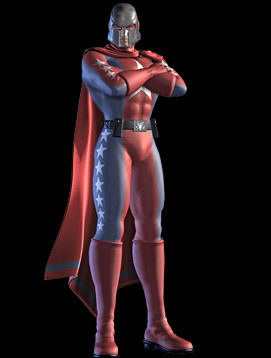
Marcus Cole received his powers by drinking from the Well of Zeus, at the same time as his one-time best friend, Stephen Ricter did. Ricter became the menacing ruler of Arachnos, Lord Recluse, while Marcus became the world's greatest hero, Statesman. Leading several generations of heroes through the Freedom Phalanx, Statesman has been a steadfast protector of mankind from threats both native to Earth, and from far beyond.

Why he's number 3: Statesman is actually a pretty straight-forward alternate version of Superman. World's greatest hero, superstrong, invulnerable, and even wearing a similar color scheme. (Actually, one of only a few on this list who shares colors with the last son of Krypton.) He also shares the fact that it was his presence in that universe that prompted other heroes to come forth. Where he's mostly different from Superman is that his role in the universe *must* be downplayed in order to make players of the game feel important enough. He also lacks an achilles heel like Superman does.

2) Icon (Milestone Comics)
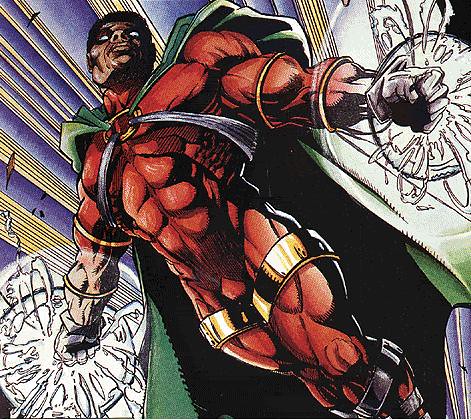
An alien starliner malfunctioned and exploded, jettisoning a life-pod in the middle of a cotton field in the American South. The life-pod made its passenger mimic the first-life form who found it, in this case, a slave woman. The alien is still with us, disguised as his own descendant and using his superhuman power to perform quiet acts of charity, until one night when a teen girl, Raquel, sees him use his powers. Raquel persuaded Augustus to become a superhero named Icon, with herself as his sidekick.

Why he's number 2: Icon's creators dismissed seeing him as "the black Superman," but it's hard to deny the similarities. Icon's race may still be out there waiting for him, but he's had no more contact with them then Kal-El has. The idea that the life-pod altered the alien to resemble humanity is a carry-over from Superman's origin as well, at least in some versions, and most "possible futures" show that Clark either doesn't age, or does so very slowly. There are only two reasons why he doesn't actually take the number one spot: The first, obvious one is that he's black - something which cannot help but color his perception of humanity. The second one is a bit more subjective, but in my mind is significant, and that is the fact that he has met Superman, in-continuity (at least for him). It's harder for me to say "you're another version of Superman" when the character has met the man.

1) Supreme (Image Comics - Alan Moore version)
Supreme is really Ethan Crane, a mild-mannered artist for Dazzle Comics, who received his powers as a result of a childhood exposure to a meteorite composed of pure Supermium, a meta-element that can alter reality. When not saving the world as the archetypal superhero, Crane illustrates the adventures of Omniman, a Supreme-like character undergoing a re-launch with a change of writers.

Why he's number 1: Once Alan Moore got his hands on this character, Supreme became what the others on this list only flirt with - a method of discussing the role of Superman in comics and within it's universe. Through the meta-narrative, Supreme illustrates the changes that have come in a character with sixty years of history. Supreme has a supporting cast that is as closely a mirror of Superman's as he is of the man himself. Moore also used the cliches which are a part of Superman's mythos without his customary irony - and he himself has said that Supreme is, in part, an apology for the deconstruction of comics that he has been blamed/credited for. I adore V for Vendetta, Watchmen, Miracleman, The Killing Joke, the League of Extraordinary Gentlemen and others, but if I could only have one Alan Moore graphic novel on a desert island? It'd be Supreme: The Story of the Year.

So, there's my top ten. Who do you think I missed? Who do you think belongs elsewhere on the list? I'd love to hear.

Labels: ,

Monday, July 23, 2007

Will the real Son of Zor-El please stand up?

It's really kind of funny, actually. The creators of superheroes have shown themselves to be phenomenally creative in what abilities our champions (and their foes) can possess. Hard sound constructs? Check. Molecular manipulation? Sure thing. Probability alteration? No problem. Telekinetic hair? Uhhhh.... sure.

So why is it that our greatest heroes tend to be flying strongmen?

Superman has lots of other powers, sure. But he's essentially a guy who flies around and is massively strong and tough. And he's not alone.

(And no, I'm not referring to the fact that with as many other Kryptonians running around as there are, it seems like the only people who died when Krypton blew up are Jor-El and Lara.)

But let's run down my top ten pastiches of the Man of Steel. Note that this list is based on nothing more than my own subjective rankings, and I might change it at any moment. I also intentionally left off of the list characters directly related to Superman; this includes other Kryptonians (Supergirl), clones (Superboy, the Cyborg Hank Henshaw), those inspired by Superman (Steel), other alien races that are almost Kryptonians (Mon-El), and alternate universe versions of Superman (Ultraman).

All of these characters are super-strong, fly, and are near invulnerable. But they each have some significant differences as well.

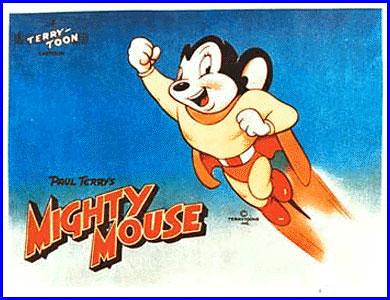
10) Mighty Mouse
Singing his trademark song, "Here I come to save the day!", Mike Mouse becomes the super-powered Mighty Mouse! Flying to rescue Pearl Pureheart, there is little that can slow down this marvelous rodent.

Why he's number 10: Because, well, he's a mouse. He's also the least developed character on the list - his cartoons rarely dealt with Mike Mouse's life, and no specific vulnerabilities were ever discussed.

9) Apollo (Wildstorm)
Bio-engineered member of a little known Stormwatch team, the man known as Apollo is able to channel solar energy through his body to devastating effect. Both as a member of Stormwatch, and then later with the Authority, Apollo has shown himself ready, willing, and able, to be an effective warrior against evil.

Why he's number 9: There are a number of major differences between Apollo and the Man of Steel (though none quite so glaring as being a flying rodent). To begin, he is visually the most distinct from the Man of Steel. Secondly, Apollo is a homosexual man, married to the Midnighter. Third, he maintains no secret identity. Superman knows the importance of being Clark Kent, but Apollo is always Apollo. Finally, Apollo is willing to kill. He's clearly cast in Superman's mold, but the mold was pretty well warped.

8) Captain Marvel (DC Comics)
When Billy Batson invokes the name of the wizard Shazam, he is granted the Wisdom of Solomon, the Strength of Hercules, the Courage of Achilles, the Power of Zeus, the Stamina of Atlas and the Speed of Mercury, becoming Captain Marvel, the world's mightiest mortal. The protector of the Rock of Eternity, where the Seven Deadly Sins are imprisoned and Fawcett City, Billy is joined by his sister, Mary, and their friend Freddy, who become Mary Marvel and Captain Marvel, Jr., respectively.

Why he's number 8: The similarities between him and Superman were great enough that Fawcett was sued by Timely comics, and lost the ownership of the character, so you'd think he'd be higher. But really the Marvels are amazingly distinct. Firstly, their powers are magical in nature, where Superman is highly tied to science - so much so that he is vulnerable to magic. Secondly, and they are unique on this list in this, those who possess the power of Shazam are ordinary humans most of the time. The relationship between the Marvels and Black Adam is also unlike anything in the Superman mythos. I like Marvel more than any of the others here, including Superman himself sometimes, but he's really very little like Superman. He also doesn't get the respect he deserves from the people of his comic universe - all of those higher ranked on the list are usually regarded as the "greatest hero of all" or darn close. While Marvel probably is, the people of the DCU don't see him that way.

7) Mr. Majestic (Wildstorm)
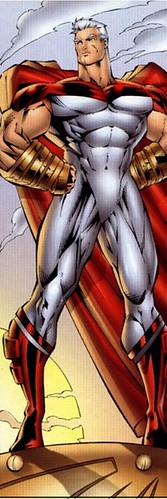
Majestros is an alien warlord who has come to Earth, where he has become the single greatest hero on the planet. His strength, invulnerability and other powers are so awesome and varied that his name has led to an entire classification of superhumans. Whether in his native world, on Earth, or even transported to another dimension, Majestic is a force to be reckoned with.

Why he's number 7: Majestic was specifically created to mirror Superman - so much so that when Majestic was transported to the DCU, many people believed him to be Superman with a change of costume. Beyond strength, speed, invulnerability and flight, Majestic is also an absolute genius. But his attitude couldn't be more different than the Man of Steels. Majestic is a warlord, first and foremost. He fights pre-emptively, and is not above killing if it is needed. He answers to no authority beyond his own, unlike Superman who takes the laws and morality of humanity to heart. He also is Majestic all the time, except for a short time when he did live as a human - at Superman's own suggestion! He would rank lower, but Majestic is considered the mightiest hero of his Earth, and as such, he fits Superman's role for the Wildstorm Universe.

6) The Sentry (Marvel Comics)
Robert Reynolds possesses the power of a thousand exploding suns. (What that means precisely is up for debate). He is one of the Earth's greatest heroes (sometimes), and the Golden Guardian of Good is now a prime member of the Avengers. Though suffering from a troubled past, and an immeasurably fierce arch-foe in The Void, Bob is one of Earth's mightiest champions.

Why he's number 6: The Sentry may, in theory, be Marvel's Superman, but Clark would take one look at Robert and say "We need to get you assistance." The Sentry actually almost approaches the pre-Crisis Superman in terms of his powers and abilities - especially in their vagueness. No one seems quite willing to precisely define Robert's powers - this is even more true when you consider that the Void is a part of him as well. And here's where he differs most from Superman - The Sentry is his own worst villain. And even when not in battle with the Void, Robert suffers crippling self-doubt. Clark may occasionally wonder if he's doing the right thing, but inaction is never an option for him.
So, there's numbers 10-6. We'll handle the Top 5 in a later post. Stay tuned!

Labels: ,

Friday, July 13, 2007

Superheroes aren't for kids anymore?

Let me begin by saying that I haven’t actually seen Transformers yet.

But Transformers is only the latest in a long line of movies that raise the question of “Who is this movie for, exactly?”


Superman Returns, Spider-Man (1, 2 and 3), Batman Begins, Star Wars: Revenge of the Sith - the list goes on an on. All of these are movies that I watched and enjoyed. All of them are films that, as a fan of the genre (Ok, sure, Star Wars isn’t a comic-book movie. But if the Jedi aren’t superheroes, they’re certainly close cousins.) I deeply enjoyed. They were high-action, reasonably well acted and had incredible special effects.


1978’s Superman directed by Richard Donner may have made you believe that a man can fly, but Superman Returns made the orphan from Krypton believable as a near-god.


Until, of course, it didn’t, and we saw Kal-El stomped into the dirt by Lex Luthor’s goons.


And here is where I stop and wonder, “Who are these forms of entertainment for?”


As an adult fan, I can appreciate the darker, more violent, and more realistic storylines. The brutality of the fights in Spider-Man show what a superhero fight would really be like. The devastation and mistrust in Marvel’s Civil War make total sense to me.


But as a parent… I worry. My love for Star Wars, superheroes, the Transformers, and even G.I. Joe were formed as a child. And I don’t know that films in this genre which routinely get a PG-13 rating are going to do the same thing for the new generation of kids. More importantly, I don’t know that they should.


I saw Transformers: The Movie when I was nine. But I wouldn’t want a nine-year old seeing Michael Bay’s Transformers. I want to go see it, sure. But there’s a world of difference between seeing an animated Cybertron eaten by Unicron and watching giant robots smash realistic automobiles with people still inside of them.


I don’t know what the answer is, mind you. As an adult fan, I want these “more mature” genre films to be made. What held my interest at twelve may not do so at thirty. But I want a Superman movie I can share with my daughters. I want to be able to take my kids to a time long, long ago in a galaxy far, far away and let them thrill at the desperate struggles of the Rebel Alliance.


This isn’t about strict adherence to the originals. I don’t want that. Make the spider which bites Peter Parker a genetically modified spider created by Oscorp instead of a radioactive spider. Change the membership of the X-Men. Redesign the Autobots and Decepticons to reflect modern vehicles. That’s fine. Strive for storylines that will engage the original fans of the properties, now adults. But can’t we still have something that the kids of today can enjoy?


Or maybe I’m wrong. Maybe I need to accept that Transformers, and Star Wars, and Spider-Man and Superman and Batman and all the others aren’t for our kids. They were ours as kids, and they’ll remain ours – passing away to obscurity as we grow older and die. And fifteen years from now, some bright director will remake Pokemon for the twenty-somethings of the year 2020. And it will be dark and gritty, and inappropriate for their kids, who will have their own new mythology created for them.


But I kinda hope not.

Labels: , ,